
How would you like to help?
The Arab Image Foundation offers internships throughout the year.
Volunteers make an invaluable contribution to our work.
There are currently no job openings at the Arab Image Foundation.
At the Arab Image Foundation premises in Beirut, we not only care for our collection but also welcome students, researchers, artists, and members of the public eager to learn more about the AIF’s work, and photography in general.
Events

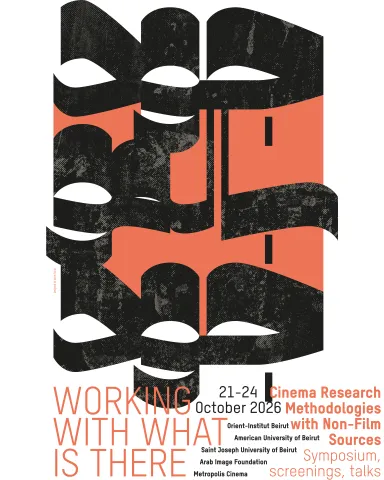
The Arab Image Foundation hosts the screening of two films: "Wanted" by Ali Essafi, and "Have You Ever Killed A Bear? - or Becoming Jamila" by Marwa Arsanios, followed by a roundtable titled "Film as Character: Re-circulating Cinema's Paratexts", on Saturday October 24, starting at 17:30.
17:30 | Screening
Wanted (Ali Essafi, 2011, 28’, Arabic with English subtitles)
In Morocco during the 1970s, known as “the years of lead,” Abdelaziz chose to live in hiding to escape repression and continue his career as a left-wing activist. Wanted is an archival film that unearths the intense artistic creativity that the spirit of rebellion in the 1970s had managed to unleash.
Have you ever killed a bear? – or Becoming Jamila (Marwa Arsanios, 2013, 25’, Arabic with English subtitles)
Issues of the Egyptian Al-Hilal magazine from the 1950s and ‘60s are the starting point for an inquiry into Jamila Bouhired, the Algerian freedom fighter. An actress designated to play her role is showing the magazine’s covers to the camera. From the different representations of Jamila in cinema to her assimilation and promotion through the magazine, Arsanios’ video attempts to look at the history of socialist projects in Egypt, anti-colonial wars in Algeria, and the way they have both promoted and marginalized feminist projects. The clear gender division used to marginalize women from the public sphere was overcome for a short moment during the Algerian war of independence (Jamila becoming its icon). Various voices, film and print materials are used to explore this history.
18:30 | Roundtable
Film as Character: Re-circulating Cinema's Paratexts
In this roundtable, publishers Abboudi Bou Jaoude (Al-Furat Publishing) and Martine Derain (Éditions commune) will discuss the transmission of historical publications – from hand to hand, from one artistic medium to another, and across generations. Unpacking collections of film posters and magazines that have informed the making of their books (“Tonight” Cinema in Lebanon 1929–1979, Le livre pour sortir au jour de Jocelyne Saab, and Al-Tariq), they will debate methodologies that go beyond lamenting loss – the digitization, translation, and the artistic re-purposing of parafilmic documents – in conversation with researcher Ghenwa Hayek.
In Arabic and French with consecutive translation in both languages (no English translation).
This event is organised as part of:
Working with What Is There • Cinema Research Methodologies with Non-Film Sources
Symposium, screenings, talks
Beirut, 21–24 October 2026
Co-organized by Anaïs Farine and Philip Widmann, in cooperation with Orient-Institut Beirut, University of Zurich, American University of Beirut, Saint Joseph University Beirut, Metropolis Cinema, and the Arab Image Foundation.
Supported by the German Research Foundation (DFG), the Swiss National Science Foundation (SNSF), Bobst-AUB Collaborative Initiative, the Finnish Institute in the Middle East (FIME).
Working with What Is There gathers contributors to present alternative approaches to cinema history informed by non-film sources. It invites to think and create with films as mutable objects of circulation between people, across generations and media, irrespective of their material survival as film copies.
To learn more and see the full programme, please visit the Orient-Institut Beirut's website.
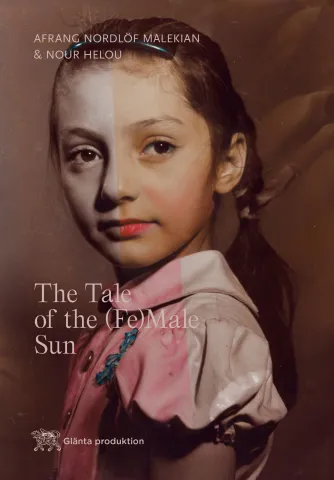
The Arab Image Foundation photographic archive in Beirut houses collections of hand-colored Iranian photographs from the 1960s, 70s, and 90s. When artist Afrang Nordlöf Malekian digitized and documented these images during his residency at the Arab Image Foundation in 2019, he noted that people’s faces were meticulously retouched in a manner similar to his contemporary Iranian passport picture. The process had yielded smooth and saturated images with shades of magenta, blue, and red. In collaboration with art historian Nour Helou, whose Lebanese passport photograph had been subjected to the same type of editing, Nordlöf Malekian initiated an exploration of Southwest Asian and North African beauty standards.
In the book The Tale of the (Fe)Male Sun, Afrang Nordlöf Malekian and Nour Helou narrate a story of the rise and fall of hierarchical beauty standards in Southwest Asia and North Africa through mythologies, anecdotes, history, Qajar paintings, handcolored photographs, with cassette and vinyl covers. What rises from the pages is the story of how a little star in the cosmos transformed into an almighty sun, both female and male. In their light, nonbinary gender expressions in painting, music, and dance flourished, nurtured by the desire of royals and artists. But over time, the gender-transcending sun came to be eclipsed by a new, faceless sun. Now in the shadows, but not forgotten, the (fe)male sun occasionally sneaks out from behind the faceless sun – like in this book – reminding us of their former glory. All in the hope that one day, we will greet this sun again, like an old friend shining by our side.
Please join us on October 8th at 7pm at the Arab Image Foundation for the launch of the book in Lebanon, which will feature a conversation between Nour Helou and artist and researcher yasmine habib; with readings by Farah F. Naboulsi and Serge Harfouche.
During the evening, the book – published by Glänta – will be available for purchase at a special price!
Nour Helou (B.A. American University of Beirut; M.A. New York University) is a cultural worker, writer, and film curator curious about the ways we relate to each other, working across Lebanon, Sweden, and New York.
Afrang Nordlöf Malekian is an Iranian-Swedish artist based in Berlin, who through storytelling explores how entanglements between precolonial, colonial, and migratory cultural forms in hand-colored photography, social dance, Iranian pop music, and mythology can transform into evasive, flexible forces that advance collective endeavors.
Farah Fawzi Naboulsi is a film practitioner from Beirut, Lebanon, with 17 years of practice spanning documentary, fiction, performing arts, and festivals.
Serge Harfouche, peasant, activist, co-founder and current president of Buzuruna Juzuruna.
Glänta is an independent publishing house and a quarterly cultural journal based in Gothenburg, Sweden.
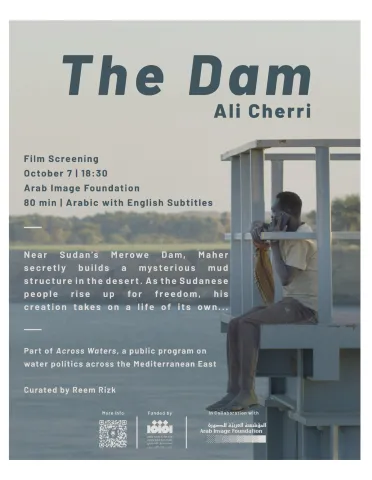
The Dam, a film by Lebanese visual artist and filmmaker Ali Cherri, screening on October 7, at 6:30 PM at the Arab Image Foundation | Aresco Center, Beirut.
This screening is part of "Across Waters" a research project and public program curated by Reem Rizk in collaboration with the Arab Image Foundation, Haven for Artists, Thkio Ppalies, and Visual Voices, with the generous support of the Arab Fund for Arts and Culture (AFAC).
Duration: 80 minutes
Language: Arabic with English subtitles
—
Sudan, near the Merowe dam. Maher works in a traditional brickyard fed by the waters of the Nile. Every evening, he secretly wanders off into the desert to build a mysterious construction made of mud. While the Sudanese people rise to claim their freedom, his creation starts to take a life of its own…
—
Ali Cherri, born in Beirut, is a visual artist and filmmaker living in Paris. Working across film, sculpture and installation, he explores how histories of violence and institutions of power shape bodies, landscapes and collective memory. Soldiers, guards, monuments and archaeological fragments recur throughout his work, revealing the tensions between authority and vulnerability, heroism and exhaustion, preservation and destruction.
Recent solo exhibitions include "Soul Witness" (WIELS, Brussels, 2026); "To Fall, Patiently" (Oakville Galleries, Toronto, 2026), "How I Am Monument" (Baltic Centre for Contemporary Art, Gateshead, 2025; Secession, Wien,
2024), "Twenty-Four Ghosts per Second" (Bourse de Commerce, Paris, 2025), "Les Veilleurs" ([mac] Marseille, 2025) and "ENVISAGEMENT" (Institut Giacometti, Paris, 2024).
Image credit: Film still from The Dam, directed by Ali Cherri, 2022. Produced by KinoElektron.
Our news
June 10, 2025
The Ramazan Collection has arrived to the Arab Image Foundation. The collection consists of an estimated 12,000 glass plate negatives spanning the 1940s to the 1970s by Kirkuk based Studio Ramazan.
September 17, 2025
We are continuing our work on the 0307ra - Ramazan Collection. The collection consists of an estimated 12,000 glass plate negatives of studio portraiture spanning the 1940s to the 1970s by Studio Ramazan. Located in Kirkuk, the studio was run by Kurdish photographer Ramazan Zamdar. This project was supported by the Gerda Henkel Foundation.
January 24, 2026- 24
The Arab Image Foundation visits Zrariye, South of Lebanon, to give a free of charge workshop, focusing on salvaging damaged photographs, stabilising and digitising them, using locally sourced and low cost material. The workshop is led by AIF's preservation team, Rawan Mazeh, Jana Khoury and Leen Aoun, alongside AIF Digitisation Officer, Asadour Kdouranian, and in collaboration the founder of project Withaqeyya, Amani Rammal.
February 5, 2026
The Cooperative of Cinema Professions launches a movie night, join us every other Thursday at AIF’s Shared Auditorium.
April 21, 2026
The following is a list of donation links for emergency relief efforts active during the recent war on Lebanon, supporting people forcibly displaced by Israel's attacks:
1.Mutual aid for Lebanon by Lebanon Solidarity Collective
This initiative aims to directly support displaced families and individuals that they have initiated mutual aid relationships with over the past 2+ years of aggression, and to fortify other trusted mutual aid efforts on the ground who are supporting recently displaced people, including migrants, refugees, and others who lack financial means and access to resources.
2. Lebanon Emergency Relief by Workers For Palestine
Funds will go toward food for those affected, buying tents and mattresses, hygiene products, baby formula, equipping spaces with basic infrastructure, and more.
3. Menstrual Kits Support by Jeyetna and AgriMovement to displaced women in Tyre, in partnership with the Disaster Risk Reduction Unit (Union of Tyre Municipalities).
4. Emergency Fund by Ma3 Ba3ed
Funds will go toward hygiene kits, mattresses, blankets, washing machines and community kitchens.
6. Raseef Beirut Community Kitchen
Preparing hot meals daily to families who have sought refuge in their neighbourhood, among them members of the Deaf community displaced because of Israel’s assault on Lebanon.
7. The Lebanese Union For People with Physical Disabilities
Provide support, protection, and guidance for individuals with disabilities and their affected families.
8. Support for Migrant Workers by Reman
Funds will go toward transport costs for women in the affected areas to reach safe locations, subsistence, including food, drinks, a community kitchen to support one-two meals per day, medication, personal hygiene items, mattresses and/or essential needs within migrant shelters.
9. Emergency assistance for migrant domestic workers by Egna Legna Besidet
Funds will go toward basic humanitarian supplies, shelter and for those who need it, medical care for migrant workers in Lebanon.
10. Nation Station Community Kitchen
Preparing hot meals and packing kits for the displaced families.
For more detailed information: with the collective efforts of these initiatives and our friends from Damj, a map detailing support initiatives in Lebanon have been created. You can check the map for Lebanon here, and for Beirut specifically as well, or visit Damj pages.